
The tea beverage industry is undergoing a subtle shift.
Moxue Bingcheng’s first Hong Kong store closed in early October, bringing the total number of store closures this year to six. Ningji took even more drastic action, completely withdrawing from the Hong Kong market in June. Guming and Hushang Auntie have explicitly stated that they have no plans to enter Hong Kong for the time being; Guming’s assessment was straightforward: “The risks of expanding overseas outweigh the benefits.”
At the same time, however, the number of Bawang Tea Princess stores in Hong Kong increased from 15 at the beginning of the year to 22 in August, and is expected to reach 24 by the end of the year—all company-owned. After a period of contraction, Heytea has resumed expansion; it currently operates 12 stores and is gradually finding its footing.
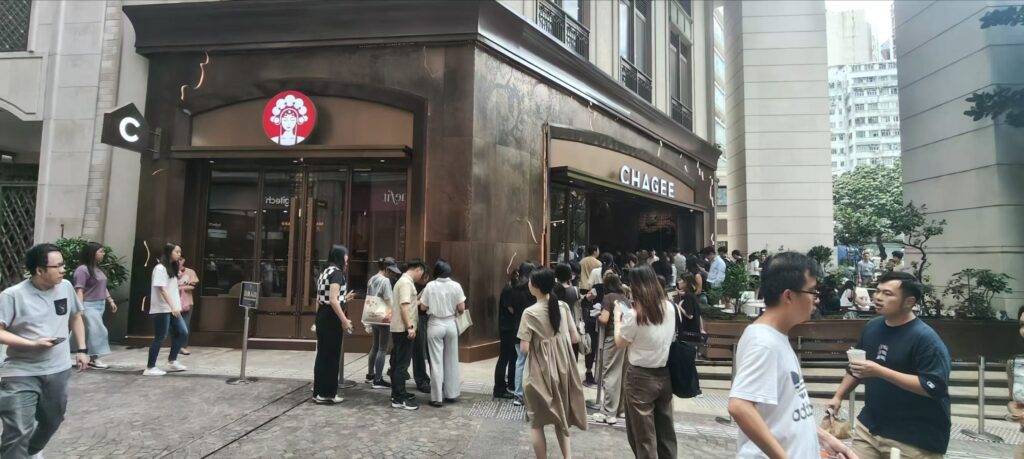
In the same market, some are pulling out while others are doubling down. This shows that the question for Hong Kong isn’t whether it can be done, but how to go about it.
The mainland tea beverage market has fully entered a phase of competition for existing customers, with revenue per store declining and the growth potential in lower-tier markets reaching its peak; finding a second growth curve has become a common challenge for all leading brands. Hong Kong is viewed by many brands as that “Incremental".
However, Hong Kong itself is not a blank slate; Hong Kong-style milk tea and iced lemon tea served at tea restaurants and ice rooms have long been ingrained in the daily consumption habits of its residents, forming an extremely solid existing customer base.
The real growth doesn't come from how many people are in Hong Kong, but from when and why Hong Kongers drink.
Hong Kongers have a unique shopping code called “3.3". At 3:15 p.m., I put aside what I was doing and went to a café to have a cup of milk tea and a pineapple bun."
This is not just a niche habit. According to statistics, Hong Kong residents consume an average of about 2.5 million cups of milk tea daily, with one in every three Hong Kong residents drinking an average of one cup per day. As the classic base for Hong Kong-style milk tea, Earl Grey tea has long been a staple of local afternoon tea and tea restaurants.
What does this mean? It means that in Hong Kong’s tea beverage market, the afternoon tea experience itself is a time-tested, high-frequency, and stable consumer trend. The fresh fruit teas and cheese foam toppings introduced by new mainland tea brands are up against palates that have been “trained” by Hong Kong-style milk tea for decades. Hong Kong consumers have high expectations for the richness and complexity of the tea base, and their standards for sweetness and mouthfeel also differ from those on the mainland.

This is exactly how Bawang Tea Princess gained a foothold in Hong Kong: rather than simply importing mainland bestsellers as-is, the brand used Earl Grey tea as a base to launch a Hong Kong-exclusive “Earl Grey Series” of specialty blends, reimagining the familiar flavors of Hong Kong afternoon tea in the form of modern tea beverages.
The existing market represents the everyday reality of Hong Kong-style milk tea, while growth comes from reinterpreting the same “3.3” concept using the language of new-style tea beverages. Whoever can truly integrate their product into Hong Kongers’ afternoon tea habits will be able to carve out growth from the existing market. Without that, they’ll just be another “milk tea shop from the mainland.”
Now that we’ve figured out the product and settled on a location, the next hurdle is an even tougher one: Will this store open on time and in compliance with regulations?
The interior design of tea shops in Hong Kong follows a completely different logic than that on the mainland. The extra time is entirely spent navigating several invisible hurdles.
First Topic: Fire Safety. Starting in November 2025, the Hong Kong Fire Services Department will implement the Registered Fire Engineer Program, under which applicants for restaurant licenses must complete a fire safety risk assessment and obtain approval. If the actual layout of the premises does not match the final plans “exactly,” the fire safety certificate will not be valid.
Dish No. 2: Ingredients. Fire-resistant panels, fire-retardant coatings, cables, and electrical switches and outlets that have test reports issued in mainland China are generally not recognized in Hong Kong. Before bringing these items onto the site, you must verify each item individually: whether a locally certified version is available, whether retesting is required, and how long the process will take.
Third Course: People. Mainland workers holding business visas are not permitted to engage in on-site construction work in Hong Kong; licensed work such as electrical, fire safety, and gas installations must be performed by locally registered professionals.
Fourth Course: Time. The mall’s regulations are stricter than the law. The Li Dong Street Mall requires that noisy construction work be carried out only between 2:00 p.m. and 6:00 p.m., which severely limits the daily window for construction work.
These hurdles won’t appear in a brand’s business plan, but they directly determine whether a store will be able to open its doors on the scheduled opening date.
In 2025, Guodian completed the renovation of the Ba Wang Cha Ji store on Lee Tung Street in Hong Kong—a 570-square-meter space—and delivered it in 80 days.
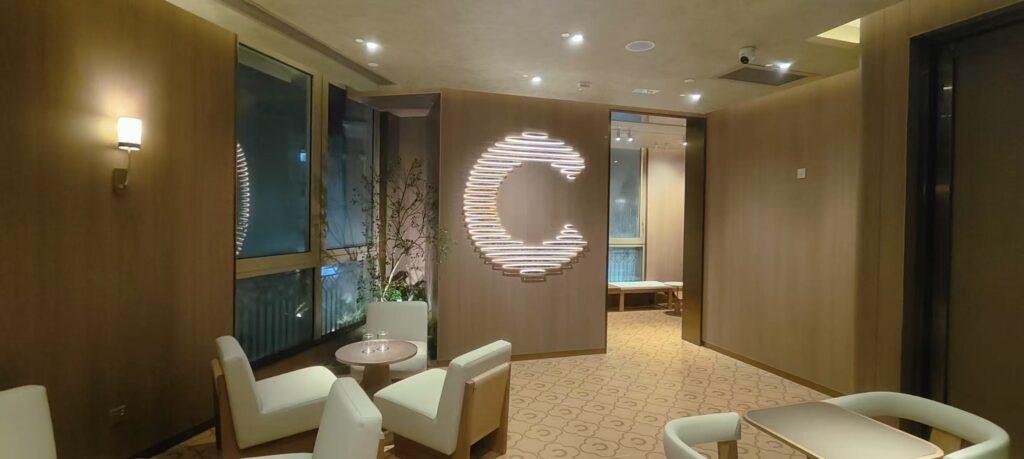
When working on a construction project in Hong Kong—completing a 570-square-meter high-end retail space in 80 days—it means there can be absolutely no rework at any stage of the process. There are clear differences between Hong Kong and mainland China standards regarding sprinkler spacing, alarm systems, and evacuation route widths, so the drawings require at least three to four revisions. Before breaking ground, we had a fire safety consultant review the plans, compiled a list of material certifications, and secured schedules for licensed workers. With construction time at the mall severely compressed, we broke down the work into separate phases, carefully scheduling noisy operations strictly within permitted time windows and scheduling quiet tasks—such as installation, assembly, and cleanup—outside those windows. Only by ensuring that all four key factors—fire safety, materials, labor, and time—were fully addressed in advance were we able to transform the 570-square-meter space from a shell into a store ready for opening within 80 days.
Following the opening of its Lido Street location, Bawang Chaji continues to expand its store network in Hong Kong. Whether a brand can consistently open new stores in a given market depends primarily on the strength of its products, but the successful physical opening of each new store hinges on whether the first project has truly established a clear path to compliance and set construction standards.
When tea brands expand overseas, it’s easy to talk about “finding new growth opportunities.” The real challenge lies in creating a tea that fits local afternoon tea customs, fitting it into a space that complies with all of Hong Kong’s regulations regarding fire safety, materials, labor, and construction timelines—and then opening for business on the scheduled date.
Existing business is driven by products, while new growth is realized through implementation.
What Guodian does in Hong Kong is ensure that the second phase goes off without a hitch. If you’re planning to open a store in Hong Kong—whether it’s a tea shop or a full-service restaurant—reply “Hong Kong” in the comments to receive the *Hong Kong Restaurant Renovation Approval and Compliance Checklist*. We don’t talk about concepts; we focus on getting your store up and running on time.
 English
 Chinese
 Vietnamese